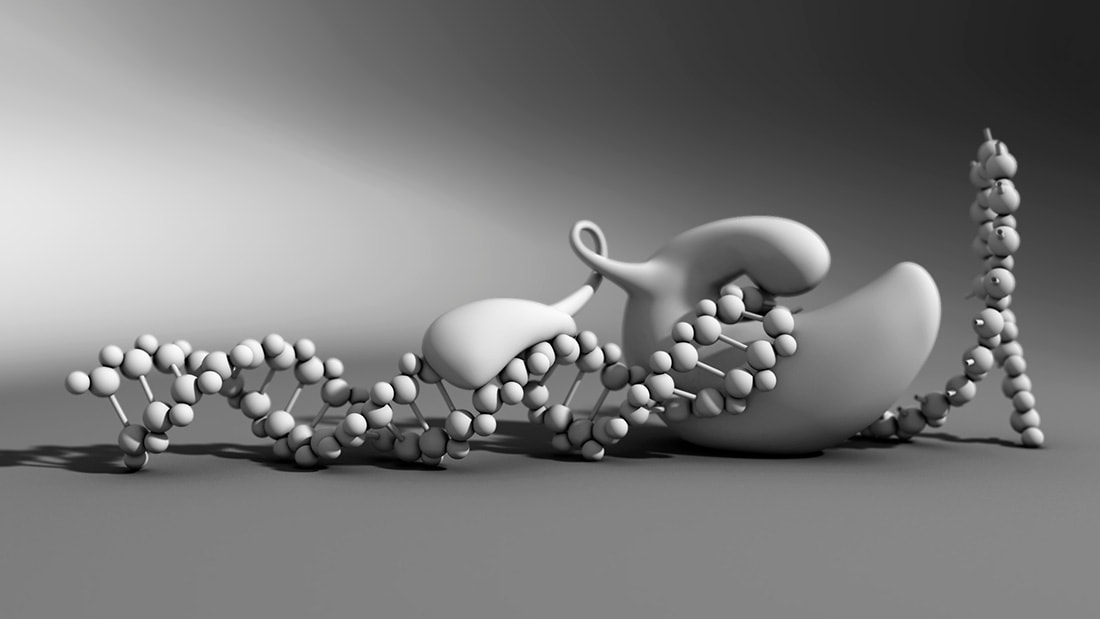
Wired up a Half-Lambertian shader. It's a nice technique for simulation slight subsurface light scattering or very rough objects where light energy would be transmitted from it's hit location to nearby matter. Nice soft fall-off made famous in this Valve paper.
Picture
Half-Lambertian diffuse shader
I've uploaded a preset for this material. Note that this material uses a vector share node (I've commented it) to calculate shading; not a light.
halflambert.preset
File Size: 91 kb
File Type: preset
Download File

Picture
shader noodle
Half Lambert - Windows
File Size: 445 kb
File Type: wmv
Download File

Half Lambert - Mac
File Size: 412 kb
File Type: mov
Download File


Crawler

02/13/2011

 
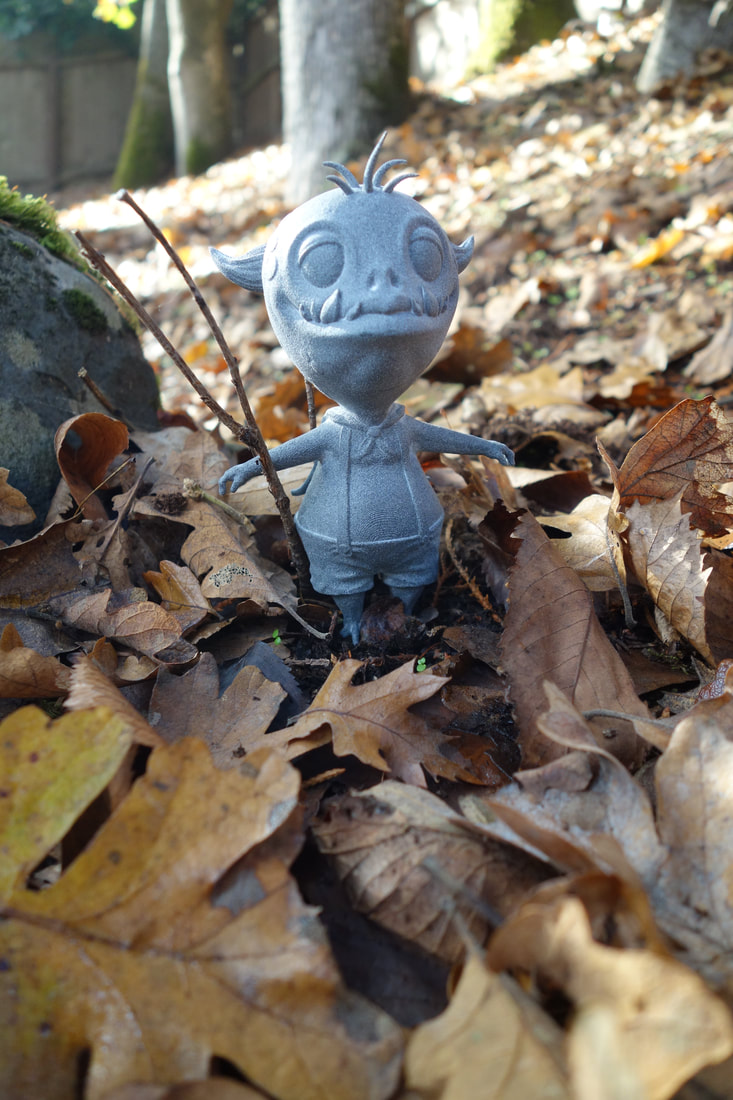
Sit, Ubu, sit! Good dog.
Picture
clay render
Crawler Turn Table - Windows
File Size: 1008 kb
File Type: wmv
Download File

Crawler Turn Table - Mac
File Size: 2095 kb
File Type: mov
Download File

Picture
shade & wire viewport
Picture
UV layout
Picture
detail close-up; teeth & feet
Picture
rig
Go fetch.
 
 
Many game engines are using deferred rendering these days as opposed to forward rendering. In addition, many movie shots have been authored with deferred techniques and then assembled and shaded in Nuke. The concept for both real-time engines and offline renderers is basically the same; to encode 3d data into 2d space (buffers) and then solve for the lighting/shading as a post process. If you are interested in lighting/shading in post, check out the Postlight tool by Andy Nicholas.

This deferred texture mapping test is a similar idea and mimics this tool by RevisionFX. For offline rendering, this additional UV vector pass can save re-rendering an image/animation by allowing me to swap textures after rendering is complete.
Picture
deferred texture mapping concept
The Component Parser is the compositing node used to map the texture to the UV vector data. The variable a1 = horizontal pixel count of the image and variable a2 = the vertical pixel count.
Picture
compositing node graph
UV Vector Pass - Windows
File Size: 1318 kb
File Type: wmv
Download File

UV Vector Pass - Mac
File Size: 2587 kb
File Type: mov
Download File

Objects can be easily textured in post. Swapping textures is real-time without the need to re-render.
Texture Swap - Windows
File Size: 1155 kb
File Type: wmv
Download File

Texture Swap - Mac
File Size: 1677 kb
File Type: mov
Download File


This is a great cheat for low cost 'dynamic' lights. If you bake lightmaps in passes, this is a very easy effect to author.
Baked Dynamic Light - Windows
File Size: 723 kb
File Type: wmv
Download File

Baked Dynamic Light - Mac
File Size: 547 kb
File Type: mov
Download File

Essentially I combine two lightmaps; adding the dynamic map over the base map. For this demo, I do exactly that. In practical application, you would not want to double your lightmap textures space for a whole level. Instead, create a pass where duplicate chunks of localized geometry will hold low resolution dynamic maps (or even make a larger texture sheet for all the dynamic maps in your level, a 512x512 will do) and bake to a new set of UVs.
Picture
combining light maps in realtime for dynamic FX
 
 
Using the toon shaders for illustrative renders. I made some line art, burned some screens, & printed the kiddos some cool custom T-shirts!
Picture
Picture
Picture
Picture
Picture
 
 
Displacement test with the 3delight renderer.
Picture
very little render penalty (if any) with a REYES renderer
 
 
There is a lot of flexibilty, production time-savings, and specific look development which can be gained by building lightmaps (for realtime engines) in passes. Using mental ray, these passes are fairly easy to setup and bake. However, while final gathering (FG) works great (result-wise) for radiosity sampling, it is only single threaded when used for rendermapping. Seeing as how FG is a screen space method for sampling, I don't know if this can be called a bug (definitely an oversight). This limitation is made worse when several computers are used via satellite rendering to generate a single lightmap (or lightmap pass). The other systems sit idle, while one machine (using one core) calculates the FG prepass.
To avoid this production slow down and get your systems rendering with full CPU power, an environment sampling shader can do the work FG would normally calculate. Using mental ray's ambient occlusion shader with the below parameters, I generated the environment sampling with satellite rendering using 100% of 24 cores.
Picture
pass material setup
Picture
environment sampling pass: using the occlusion shader for ambient lightmaps
Use this sampling method with interactive IBL light domes for a fast and iterative lighting solution.
 

IES Light Profiles

11/01/2010

 
Here is the collection I use the most; feel free to download the .zip file. I took the liberty of giving the IES files artist friendly names. Using IES profiles to scatter indirect light energy into a scene gives a certain legitimacy to the render; even if the profile isn't used for light scatter effects directly. You can accomplish indirect scatter by setting up photon only lights with an IES profiles.
IES_Profiles.zip
File Size: 35 kb
File Type: zip
Download File

Picture
IES profile collection
Picture
IES light scatter
 

Glass Shader

10/17/2010

 
Wired-up an interesting glass shader.
Picture
Picture
 

Grunge Texture Map

10/02/2010

 
Grunge texture test for the Rolls Royce Phantom model.
Picture
junkyard dog
Picture
8k grunge texture